


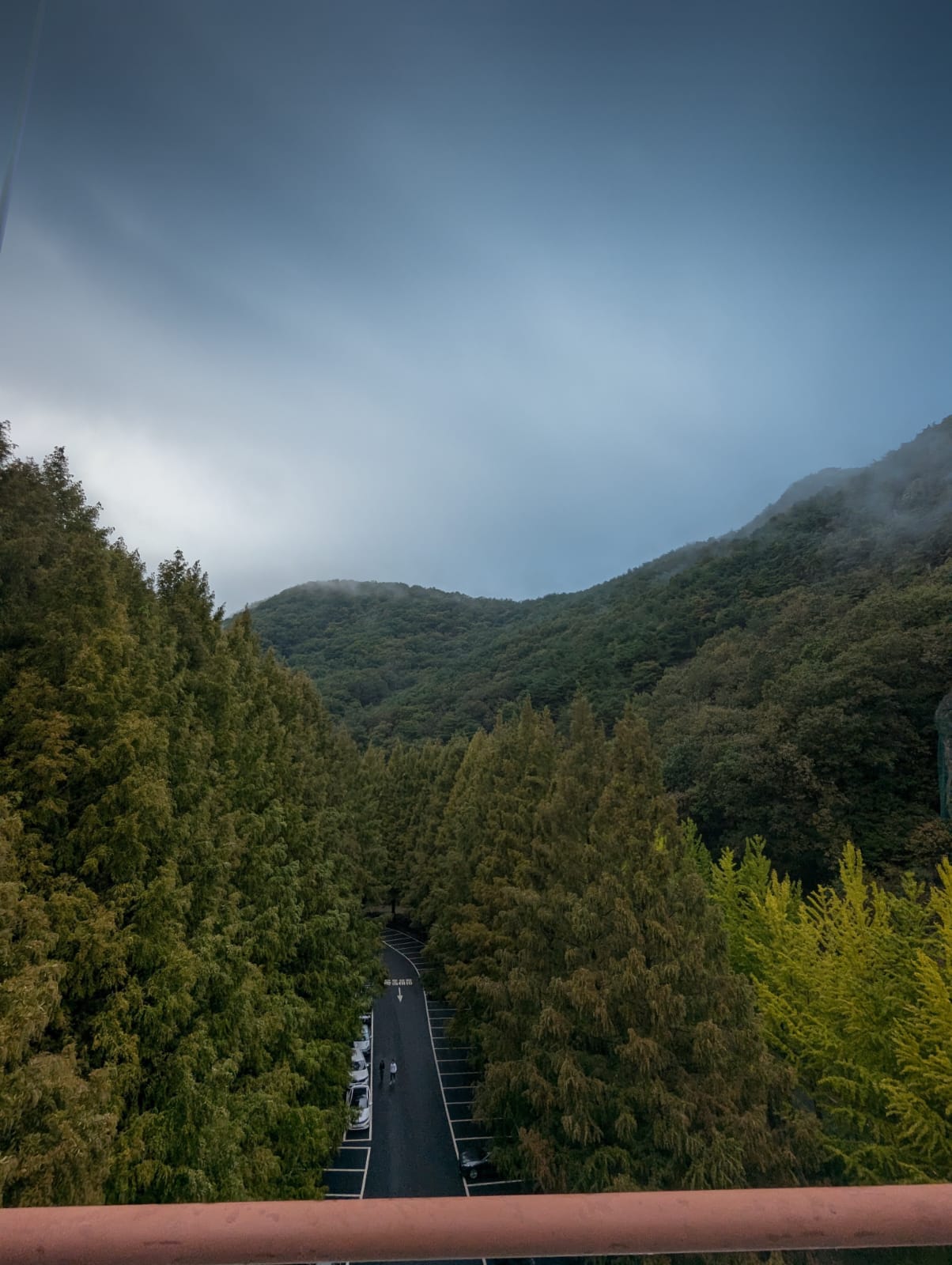

South Korea’s forest recovery is often told as a story of mass tree planting. But once reforestation succeeded, the real challenge changed: managing wildfire, pests, and climate risks in an already forested landscape. This essay argues that Korea’s shift toward digital forest governance was not simply technological modernization, but a response to a new phase of forest management.
#forest governance #digital monitoring #wildfire risk
South Korea’s reforestation story began as a national crisis, not an environmental success story. By the late 1950s, 58% of the country’s mountains were bald and 11% of its land was considered barren. Forest degradation had become a development problem, worsening floods, soil erosion, and rural energy shortages.
What changed in the 1960s was not the forest overnight, but the state’s ability to restore it. The government built the legal and institutional foundations through the Forest Law of 1961, the Erosion Control Act of 1962, and the creation of the Korea Forest Service in 1967. In that sense, Korea’s forest recovery began as an institutional project before it became a biological one.
The real turning point came in 1973 with the First National Forest Plan. Korea paired mass tree planting with strict monitoring through the Geommok tree inspection system, which checked seedling survival rates through field inspections and cross regional verification. Even before the digital era, forest governance in Korea was already becoming measurable, disciplined, and results oriented.
Before turning to digital governance, it is important to understand that Korea’s forest challenge did not disappear after reforestation. It changed. To capture this transition more accurately, it is useful to look beyond forest area and focus on forest density, measured by growing stock per hectare.
Although forest area classifications can remain high even when forests are degraded, Korea’s domestic statistics on growing stock per hectare show a clearer degradation-to-recovery trajectory. As growing stock rose sharply over the decades, the policy challenge shifted: from restoring forests to managing the risks faced by a mature forest landscape.
Reforestation did not eliminate forest risk. It changed its form. As South Korea’s forests matured, the policy challenge shifted from restoring tree cover to managing a landscape exposed to periodic but increasingly severe wildfire events. The issue was no longer simply whether forests existed, but how resilient they were under conditions of climatic stress and sudden disturbance.
The chart of annual area burnt by wildfires highlights the uneven but potentially severe nature of wildfire risk in South Korea. While many years show relatively limited burned area, recent spikes reveal that wildfire damage can escalate sharply in a short period of time. This kind of volatility makes forest governance more difficult, because it requires systems that can detect, assess, and respond to risk quickly rather than rely only on periodic field inspection.
As wildfire risk became faster and more spatially complex, South Korea’s monitoring tools also changed. The Korea Forest Service’s smart forest fire prediction and monitoring system, supported by the Forest Fire Situation Control System, was designed precisely for this new reality: detecting fires earlier, tracking their spread, and coordinating response in real time.
This weekly wildfire pattern helps explain why South Korea could no longer rely on analog forest monitoring alone. When burned area can surge within days, periodic field inspection becomes too slow.
As wildfire risk became faster and more concentrated, South Korea’s monitoring system also had to change. The Korea Forest Service (KFS) moved beyond periodic inspection and built an integrated real-time approach that connected detection, prediction, and emergency coordination. Through this digital shift, reported wildfire detection time fell from about 30 minutes to under 5 minutes by 2018, making real-time monitoring a core part of modern forest governance.
If wildfires reveal the speed of forest risk, forest pests reveal its persistence. In post reforestation Korea, the challenge is no longer only to protect forests from sudden destruction, but also to monitor how forest health can deteriorate over time. This makes pests especially important in the new phase of forest governance: they spread more slowly than fire, but they can accumulate damage quietly and require earlier detection.
The first chart shows that pest control in Korea is not limited to a single outbreak or a single species. Managed area remains substantial across years, and the category of “other pests” accounts for the largest share of treated land in most years. This suggests that forest health management has become a continuous administrative task rather than an occasional intervention. Once forests matured, governance had to move beyond planting and survival rates toward ongoing surveillance of biological threats.
Within this broader pest landscape, pine wilt disease stands out as one of the clearest examples of why data driven monitoring matters. Unlike the previous chart, which tracks treated area in hectares, the next figure follows affected and controlled trees. That difference is important: modern forest governance increasingly depends on choosing the right indicator for each risk.
The pine wilt data show three distinct phases: a sharp surge in the early 2010s, a long decline through 2021, and a renewed increase in 2023 and 2024. After peaking at more than two million affected trees in 2013, the number fell substantially over the following years. Yet the rebound to over one million affected trees in 2023 and nearly 900,000 in 2024 suggests that the threat has not disappeared. Just as importantly, the recent gap between affected and controlled trees indicates that pine wilt disease remains an active management challenge rather than a solved problem.
This is where the logic of digital forest governance becomes clearer. Fire requires speed, but pests require continuity. Effective pest management depends on repeated monitoring, spatial tracking, early diagnosis, and targeted intervention before visible damage spreads across larger areas. In that sense, forest pests reinforce the same conclusion as wildfire: once forest risks become more complex, analog monitoring is no longer enough.
South Korea’s post reforestation challenge is therefore not simply to preserve forest area, but to maintain forest health. The shift from counting trees to tracking stress, disease, and vulnerability marks a deeper transition in forest policy: from restoration to risk intelligence.
Wildfires and forest pests point to the same institutional lesson: once reforestation succeeds, forest governance can no longer focus only on restoration. It must become faster, more continuous, and more predictive. In South Korea, this shift led to a new model of forest management built around detection, coordination, and real-time information.
Rather than a single innovation, South Korea’s digital forest governance is built on several interconnected systems. The following examples highlight the core strategies that make this model work in practice.
An integrated digital platform that combines satellite image analysis, high-resolution CCTV, heat-sensing drones, emergency 119 calls, and GPS-enabled mobile reports into a single response workflow. The detection time dropped from about 30 minutes to less than 5 minutes with the intelligent fire system.
Around 1,446 forest fire CCTVs are connected to AI-based video analysis, allowing real-time fire identification and automatic alerts to authorities.
A real-time control platform that receives patrol reports, app-based alerts, and emergency calls, then connects them to suppression strategy maps and field command decisions.
Beyond these flagship systems, the broader digital ecosystem of forest governance also includes additional tools for detection, prediction, reporting, and command.
Taken together, these tools show that South Korea’s digital turn in forest governance is not simply about adopting new technologies. It reflects a deeper institutional shift: from periodic inspection to continuous monitoring, from reactive response to early warning, and from fragmented reporting to integrated coordination. In this sense, digitalization has become part of how the state governs forest risk, not just how it measures it.
South Korea’s digital turn in forest governance is not entirely unique. As forest risks become more climate-sensitive, spatially complex, and harder to detect early, many countries are increasingly relying on satellite observation, remote sensing, drone surveillance, GIS-based mapping, and integrated early warning systems. In this sense, digital monitoring is becoming less of an optional innovation and more of a practical requirement in modern forest management.
These cases suggest that South Korea is part of a broader shift rather than an isolated exception. What changes across countries is the policy problem being addressed, from wildfire response to fuel monitoring to anti-deforestation enforcement. What remains similar is the underlying logic: forest governance is increasingly moving from periodic observation to continuous monitoring, from delayed reporting to early warning, and from fragmented information to more integrated systems of response. In that sense, digital monitoring is becoming less of an optional innovation and more of a practical requirement in modern forest management.
South Korea’s forest recovery is often remembered as a story of mass reforestation, but this essay has shown that its more important lesson begins after reforestation. Once forest cover was broadly secured, the central challenge of forest governance changed. The problem was no longer how to restore tree cover alone, but how to manage a mature forest landscape exposed to new and increasingly complex risks, including wildfires, pests, and climate-related stress. In this new phase, the logic of forest policy shifted from restoration to risk management.
What makes South Korea’s experience especially significant is that it did not respond to these risks only by adding new technologies. It reorganized the way forest governance works. Monitoring moved from periodic inspection to continuous observation, from delayed reporting to early warning, and from fragmented information to integrated coordination. Systems such as smart fire prediction, AI-linked CCTV, drone surveillance, and real-time command platforms did not simply improve technical efficiency; they became part of a broader institutional shift in how the state detects, interprets, and responds to forest risk.
The comparative cases also suggest that this transition is not unique to South Korea. Across Canada, the European monitoring platforms, Australia, and Brazil, digital monitoring is increasingly being used to support early detection, predictive assessment, and faster operational response. What differs is the policy problem each system addresses; what remains similar is the broader trend. Modern forest governance is increasingly moving beyond analog, episodic monitoring toward continuous, data-driven management.
The broader lesson, then, is not that every country should replicate South Korea’s tools exactly. It is that once forest risks become faster, more spatially complex, and more difficult to govern through traditional methods, digital monitoring becomes less of an optional innovation and more of a practical institutional requirement. South Korea’s experience is therefore best understood not simply as a story of technological modernization, but as a model of how forest governance can adapt when the risks facing forests fundamentally change.